
Face Proportion
The face is noticeably longer than it is wide - the most elongated of the standard face shapes. The vertical dimension clearly dominates, creating a stretched silhouette compared to rounder or squarer proportions.
Type guide
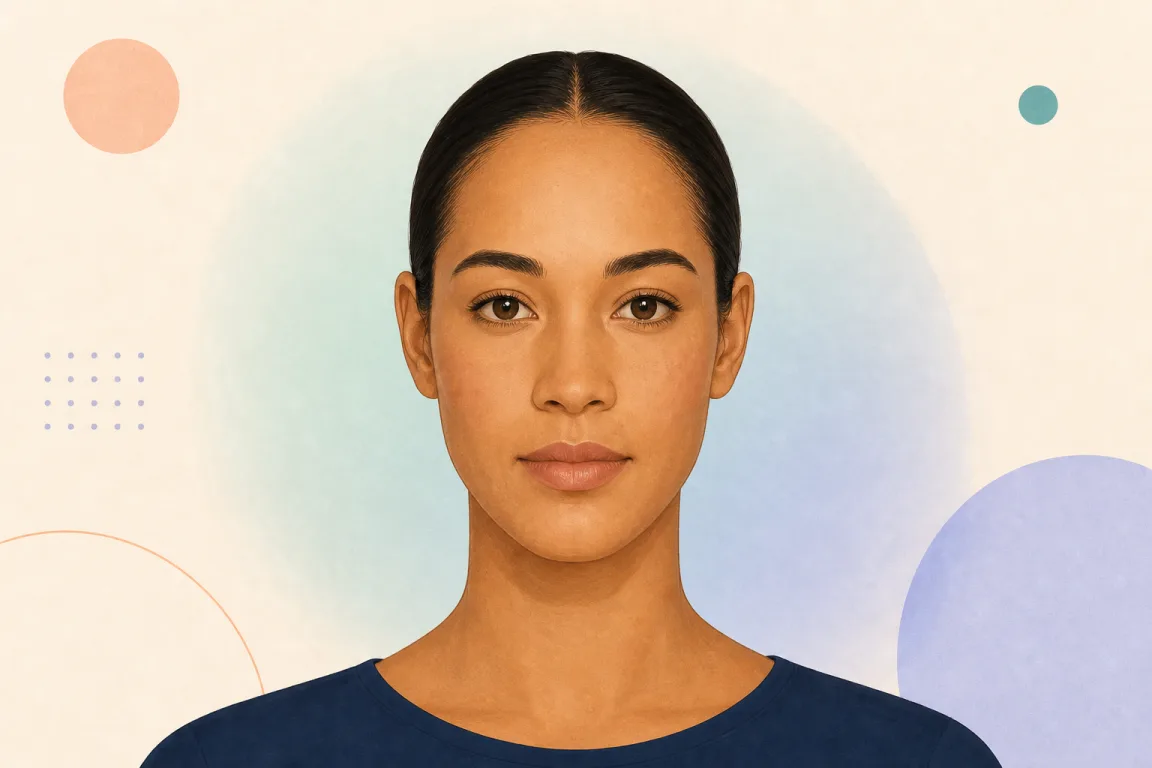
Features
An oblong face is defined by its length relative to its width. While several face shapes are longer than wide, oblong stands out because the width stays consistent from forehead to jaw rather than tapering. Here are the four features a face shape analyzer checks when classifying a face as oblong.
The face is noticeably longer than it is wide - the most elongated of the standard face shapes. The vertical dimension clearly dominates, creating a stretched silhouette compared to rounder or squarer proportions.
The forehead, cheekbones, and jawline are all roughly the same width. No single zone dominates, which gives the face a balanced horizontal profile even as the vertical dimension extends.
The sides of the face run nearly parallel from the temples down to the jaw. This is the most distinctive feature of the oblong shape and the main way it differs from oval, which tapers below the cheekbones.
Despite the length and straight sides, the chin rounds off softly rather than squaring off or coming to a point. This rounded finish distinguishes oblong from rectangular or square faces that share the even-width trait.
Proportions
In an oblong face, the vertical measurement (hairline to chin) is significantly longer than the horizontal measurement (across the cheekbones). The key measurement to watch is the width comparison: forehead width, cheekbone width, and jaw width should all be close to each other. When a face shape detector analyzes an oblong face, it identifies this combination of high length-to-width ratio and balanced horizontal zones as the defining pattern. Facial anthropometry research treats forehead, cheekbone, jaw, and face length as related proportional observations rather than a single universal beauty ratio. Facial dimension review on PMC.
Self-check
Use a front-facing mirror or photo and work through these four checks.
Face the camera or mirror head-on with your chin level. Check whether vertical length clearly dominates overall width.
Keep the forehead, sides, and jaw visible. An oblong reading keeps upper, mid, and lower width relatively even rather than strongly tapered.
Use a natural arm-length distance.
Keep a relaxed mouth and open eyes.
If your face is clearly longer than wide, the width stays consistent from forehead to jaw, the sides are relatively straight, and the chin is rounded - your face shape is likely oblong. A face shape detector can confirm by evaluating all these proportions together from a photo. For a photo-based comparison of nearby types, use the Face Shape Detector. Camera-distance proportion study.
Compare
Oblong is most commonly confused with oval because both are longer than wide. The comparisons below highlight the specific differences a face shape analyzer uses to separate oblong from its closest neighbors.
Shared: Both are longer than wide with soft, curved contours and rounded chins.
Deciding difference: An oval face tapers noticeably below the cheekbones, narrowing toward the jaw. An oblong face maintains nearly the same width from forehead through jaw, with straight, parallel sides instead of a taper.
Oval face shapeShared: Both have forehead, cheekbone, and jaw widths that are close to each other.
Deciding difference: A square face keeps its length and width close to equal, producing a compact silhouette with an angular jaw. An oblong face is significantly longer than wide and rounds at the chin instead of squaring off.
Square face shapeShared: Both have rounded chins and soft contours without sharp angles.
Deciding difference: A round face has a length-to-width ratio near 1:1, appearing as wide as it is long. An oblong face is distinctly longer than wide - the most elongated of the standard shapes.
Round face shapeShared: Both can appear longer than they are wide in some photos, especially with a pulled-back hairline.
Deciding difference: An oblong face keeps forehead, cheekbones, and jaw at a similar width with straighter sides. A heart face is relatively wider through the upper face and tapers more clearly toward a narrower chin.
Heart face shapeRead more
Full hairstyle and makeup walkthroughs live on dedicated style and technique guides. Until those pages ship, these cards open the existing personalized tools.
Review fringe, side volume, and length ideas that change the visual frame without treating face length as a problem.
Explore recommendationsGet photo-based makeup directions when you want placement ideas beyond a general type guide.
Explore recommendationsThis guide explains the type pattern. The Face Shape Detector compares a single front-facing photo against nearby face shape types and shows how close the match is.
Detect my face shape