
Balanced Face Length
The face is noticeably longer than it is wide, often described in style guides as roughly one-and-a-half times longer.
Type guide
Features
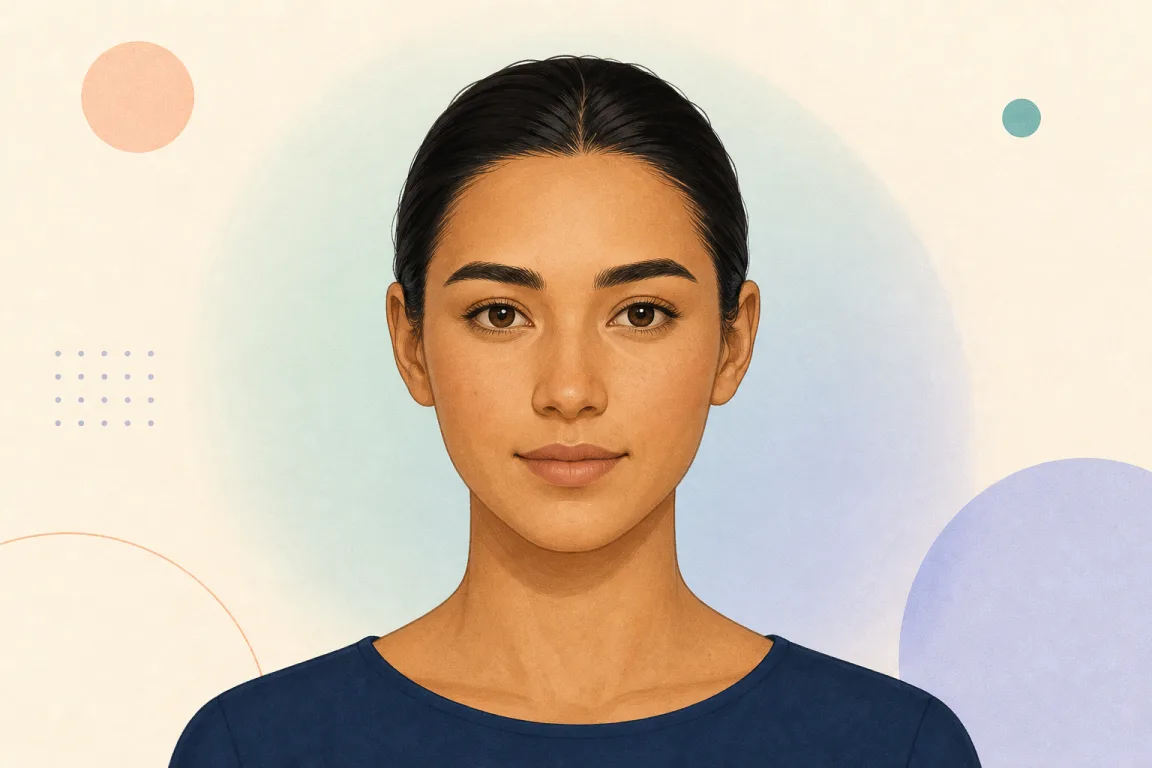
An oval face is defined by a balanced length-to-width relationship, a mid-face that carries most of the width, and a lower face that narrows gradually.
The face is noticeably longer than it is wide, often described in style guides as roughly one-and-a-half times longer.
The cheekbones sit at or near the widest point, while the forehead is usually similar or only slightly narrower. The outline does not look strongly top-heavy or bottom-heavy.
The sides move in gentle curves rather than sharp corners. From the temples through the cheekbones, the outline stays continuous instead of forming boxy edges.
Below the cheekbones, the lower face narrows gradually. The chin rounds off softly rather than staying as wide as the mid-face or ending in a sharp point.
Face measurements
Compare face length from the hairline center to the chin tip, forehead width, cheekbone width at the widest point, and jaw width. On an oval face, length is clearly greater than width, cheekbones are near the widest zone, and the jaw is narrower than the mid-face. Facial dimension review on PMC.
Self-check
Use a front-facing mirror or photo and work through these four checks.
Face the camera or mirror head-on with your chin level and eyes centered.
Keep hair off the forehead and jaw so the full outline is readable. Check whether the mid-face is wider than the lower face and whether the chin rounds off softly.
Use a natural arm-length distance instead of an ultra-close selfie.
Keep a relaxed mouth and open eyes.
If your face is longer than wide, widest near the cheekbones, soft at the sides, and gently tapered to a rounded chin, the oval label is a useful match. For a photo-based comparison of nearby types, use the Face Shape Detector. Camera-distance proportion study.
Compare
Oval is most often confused with oblong, round, diamond, and heart. Each pair below isolates one shared cue and one deciding difference.
Shared: Both are longer than wide and can have a soft chin.
Deciding difference: A long face does not automatically mean oblong. If the cheekbones remain the widest area and the jaw still tapers gently, it can still be a long oval face shape. Oblong is a closer match when the forehead, cheekbones, and jaw are more similar in width and the sides look straighter.
Oblong face shapeShared: Both can show soft jaws and rounded chins.
Deciding difference: Round keeps length and width close together. Oval is clearly longer than it is wide.
Round face shapeShared: Both can look widest through the mid-face.
Deciding difference: Diamond usually has a narrower forehead and a more pointed or narrower chin. Oval keeps a softer upper-to-lower transition.
Diamond face shapeShared: Both may taper toward a narrower chin.
Deciding difference: Heart is relatively wider through the upper face and often more pronounced at the forehead or temples. Oval keeps upper and mid-face more balanced.
Heart face shapeRead more
Full hairstyle and makeup walkthroughs live on dedicated style and technique guides. Until those pages ship, these cards open the existing personalized tools.
Browse length, bangs, and texture directions that treat face shape as one condition among hair density, growth patterns, and daily styling habits.
Explore recommendationsSee blush, contour, and brow placement options for different makeup goals. Technique still depends on features, skin, and preferred finish.
Explore recommendationsA guide can show the pattern. A photo-based check compares your visible proportions against nearby face shape types and shows how close the match is.
Detect my face shape