
Equal Length and Width
The distance from hairline to chin is roughly the same as the distance across the cheekbones, producing a near 1:1 ratio that distinguishes round faces from longer or narrower shapes.
Type guide
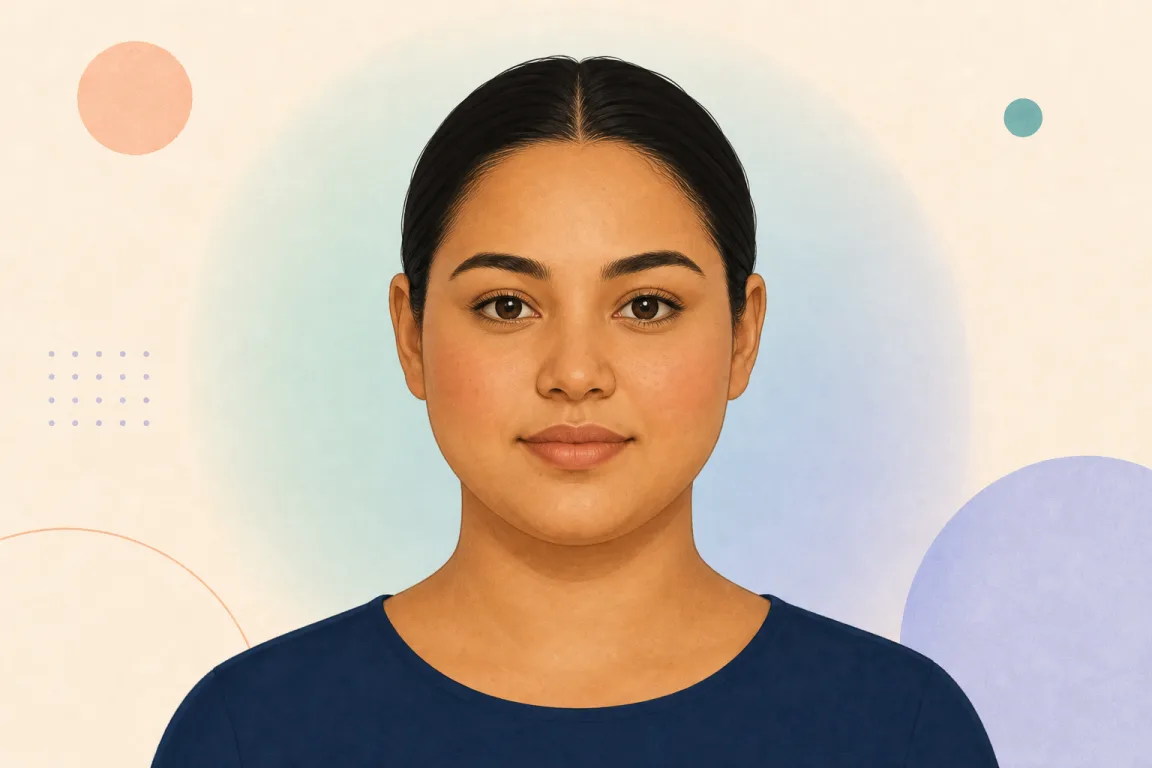
Features
A round face is defined by balanced horizontal and vertical dimensions, creating a circular silhouette. The cheekbones sit at the widest point, the jawline curves gently without angular definition, and the chin rounds off rather than tapering to a point. These proportions give the face a soft, even appearance from forehead to chin.
The distance from hairline to chin is roughly the same as the distance across the cheekbones, producing a near 1:1 ratio that distinguishes round faces from longer or narrower shapes.
The cheekbones form the broadest part of the face, sitting wider than both the forehead and the jaw. This creates fullness through the mid-face area.
The side profile shows rounded cheeks without prominent hollows or flat planes. The transition from cheekbone to jaw is smooth and continuous rather than angular.
The jawline follows a gentle curve from ear to chin with no sharp corners. The chin itself is rounded rather than pointed or squared off, completing the circular outline.
Face measurements
Take four measurements: face length (hairline center to chin tip), face width (across the cheekbones at the widest point), forehead width (across the broadest area), and jawline width (across the jaw at its widest). In a round face, face length and face width will be close to equal, cheekbone width will exceed both forehead and jaw width, and there will be no distinct angular transitions between zones. Facial anthropometry research treats forehead, cheekbone, jaw, and face length as related proportional observations rather than a single universal beauty ratio. Facial dimension review on PMC.
Self-check
Use a front-facing mirror or photo and work through these four checks.
Face the camera or mirror head-on with your chin level. Compare face length and cheekbone width; if they are close, the overall proportion leans round rather than long.
Keep the hairline, cheeks, and chin visible. Look for cheekbones as the widest zone and a jaw that curves continuously without sharp corners.
Stand about arm length from the camera.
Keep a relaxed mouth.
If all four checks align - near-equal length and width, cheekbones widest, curved sides, and a rounded jaw - you likely have a round face shape. For a photo-based comparison of nearby types, use the Face Shape Detector. Camera-distance proportion study.
Compare
Round faces share individual features with several other shapes. These comparisons highlight the specific measurement or contour difference that separates each pair.
Shared: Both shapes have a face width that approaches or equals the face length, giving a compact overall proportion.
Deciding difference: A square face has a strong, angular jawline with defined corners, while a round face has a curved jawline with no sharp transitions. The jaw width is more prominent in square faces.
Square face shapeShared: Both shapes can have full cheeks and soft contouring through the mid-face, and both tend to have narrower jaws than cheekbones.
Deciding difference: A heart face is wider at the forehead than the cheekbones and tapers to a pointed or narrow chin. A round face is widest at the cheekbones and ends in a rounded chin.
Heart face shapeShared: Both shapes have soft jawlines and lack sharp angular definition. Neither typically shows prominent jaw corners.
Deciding difference: An oblong face is significantly longer than it is wide, often with straighter sides and a more uniform width from forehead to jaw. A round face has nearly equal dimensions and more pronounced cheek fullness.
Oblong face shapeShared: Both shapes have rounded chins and smooth jawlines without angular definition. The cheekbones are prominent in both.
Deciding difference: An oval face is noticeably longer than it is wide, while a round face has nearly equal length and width. The oval also tapers more gradually from cheekbone to chin.
Oval face shapeRead more
Full hairstyle and makeup walkthroughs live on dedicated style and technique guides. Until those pages ship, these cards open the existing personalized tools.
Browse length, layers, and parting directions for round proportions.
Explore recommendationsSee blush, contour, and brow placement options for different visual goals without turning makeup into a "slimming formula."
Explore recommendationsThis guide explains the type pattern. The Face Shape Detector compares a single front-facing photo against nearby face shape types and shows how close the match is.
Detect my face shape