
Central Opening Height
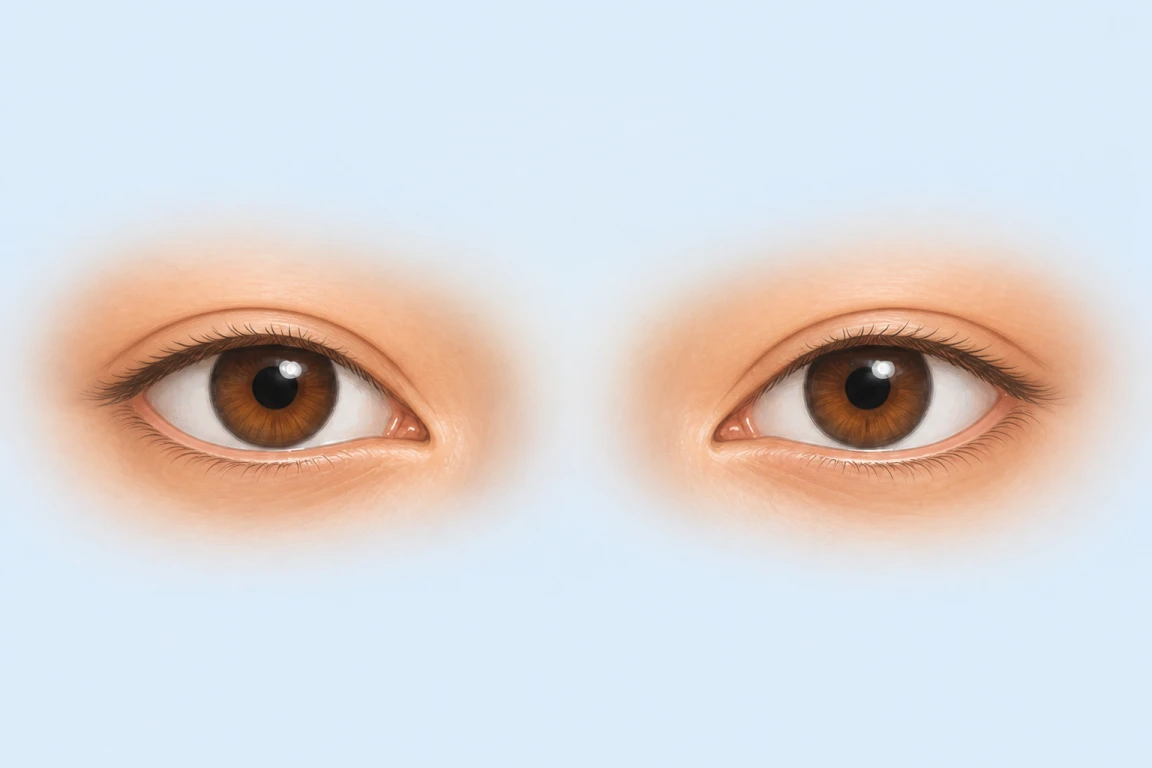
The greatest vertical distance between the upper and lower lid edges usually sits near the center of the opening rather than near either corner.
Contour guide
By KnowMyFace Team
Features
In a relaxed front view, an almond-shaped opening keeps most of its height through the middle of the eye and narrows as it approaches the inner and outer endpoints. That taper is the main contour clue.
The greatest vertical distance between the upper and lower lid edges usually sits near the center of the opening rather than near either corner.
Toward both endpoints, the upper and lower edges move closer together. That taper is stronger than a typical round opening and clearer than a softly oval contour.
The overall outline often reads longer than it is tall, but the shape still keeps readable height through the middle instead of becoming a thin horizontal line.
Whether the outer corner sits above, level with, or below the inner corner is a separate direction cue. Almond describes contour taper, not automatic upturn.
Visible geometry
A front-view reading of eye contour looks at relative width and height of the opening, how the contour tapers toward each endpoint, and whether the outer corner sits above or below the inner corner. Geometry research on eyelid contour treats the frontal outline as a two-dimensional shape that can vary independently in height, taper, and endpoint placement. Contour labels and corner direction can therefore appear together: an almond opening may also look upturned or downturned in the same photo. Geometrical basis of the eyelid contour on PubMed.
Self-check
Use a relaxed, head-level, front-facing photo with even light.
Keep both eyes naturally open.
Look forward with both eyes fully visible. A side turn can make one opening look longer, shorter, or more tapered than it does in a frontal view.
Avoid chin-up or chin-down poses. Pitching the head can raise or lower the outer corners and change how taper is read at the endpoints.
Use soft front light so the lid edges are visible.
If the center of the opening is taller than the corners and both endpoints taper clearly, an almond contour is a useful description for that photo. For a side-by-side comparison of opening, taper, and corner-direction evidence, use the Eye Shape Detector. Ideal subject distance study on PubMed.
Compare
Almond is most often confused with round contour and with upturned corner direction. Each pair below isolates one shared cue and one deciding difference.
Almond eyes illustration
Round eyes illustration
Shared
Both can look open through the center of the eye in a front view.
The difference
Round keeps fuller height nearer the corners. Almond narrows more clearly as the outline reaches each endpoint.
Almond eyes illustration
Shared
Both can appear longer than tall and may look lifted near the outer lid.
The difference
Almond names the contour taper of the opening. Upturned names outer-corner direction: the outer endpoint sits visually higher than the inner one, with or without almond taper.
Read more
These nearby pages keep contour, corner direction, framing, and makeup placement in separate jobs so one result is not forced to answer every question.
Compare a fuller corner height and smoother circular opening with almond taper.
Open guideSeparate outer-corner lift from contour labels so direction and taper stay independent.
Open guideThe Eye Shape Detector compares each eye opening and shows the supporting evidence for contour and corner direction in the submitted photo.
Open Eye Shape DetectorBrow path and peak position change how the same eye opening is framed without redefining the contour itself.
Open Brow Shape DetectorMakeup guidance can follow taper, add contrast, or shift emphasis while keeping the original contour description intact.
Open Makeup RecommendationsUpload one clear front-facing photo to compare both openings for central height, corner taper, and outer-corner direction.
See your visible eye contour from a photo