
Smooth Upper and Lower Curves
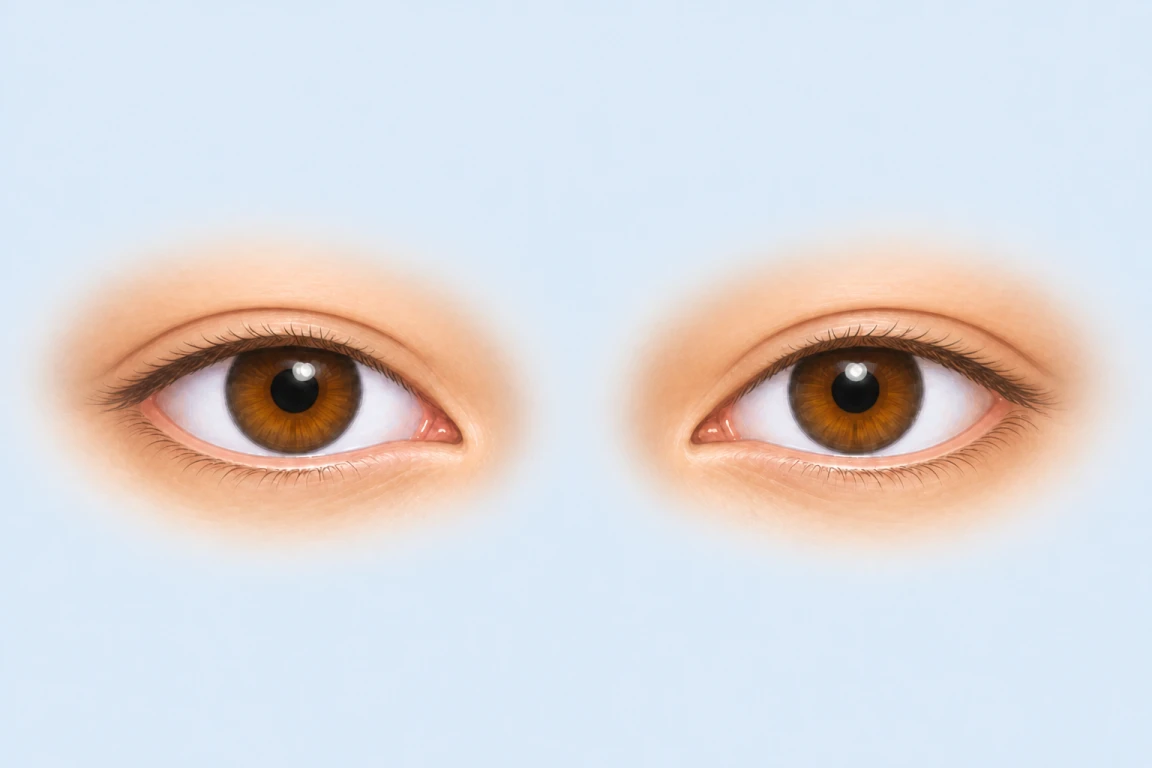
Both lid edges travel in continuous arcs rather than forming a strongly pinched almond endpoint.
Contour guide
By KnowMyFace Team
Features
In a relaxed front view, an oval opening keeps continuous upper and lower curves with moderate height and less corner pinch than almond. It is usually less circular than round and less length-dominant than elongated.
Both lid edges travel in continuous arcs rather than forming a strongly pinched almond endpoint.
The opening keeps readable vertical space through the center without the fuller circular look of a round contour.
Some narrowing can appear, but the corners usually stay rounder and less tapered than a classic almond outline.
An oval opening can still look upturned, downturned, or neutral at the outer corner. Direction remains a second layer.
Visible geometry
A careful front-view reading separates width, height, taper, and endpoint direction. Research on frontal eyelid contour geometry supports describing those outline properties independently, which is why an oval opening can still combine with any corner-direction state. Keep this page focused on the eye opening itself rather than face shape or frame shape. Geometrical basis of the eyelid contour on PubMed.
Self-check
Use a relaxed, head-level, front-facing photo with even light.
Keep a natural open gaze. A forced wide-eyed look can make a moderate opening appear rounder than it is at rest.
Both eyes should be fully visible. A turn can make one side look longer or more tapered than the other.
Keep the head level.
Use soft front light.
If the opening is moderately tall, smoothly curved, and less pinched at the corners than almond, an oval contour is a useful description for that photo. Compare nearby contours and corner direction in the Eye Shape Detector when you want photo-specific evidence. Ideal subject distance study on PubMed.
Compare
Oval is most often confused with almond taper, round fullness, and elongated length. Each pair below isolates one shared cue and one deciding difference.
Oval eyes illustration
Almond eyes illustration
Shared
Both can look balanced through the center and longer than a circular opening.
The difference
Almond tapers more distinctly at both corners. Oval keeps softer, rounder endpoints with less pinch.
Oval eyes illustration
Round eyes illustration
Shared
Both have smooth upper and lower curves and fuller centers than a thin horizontal line.
The difference
Round keeps more height for its width and a more circular impression. Oval is moderately longer and less circular.
Oval eyes illustration
Elongated eyes illustration
Shared
Both can look longer than a compact round opening and remain soft rather than sharply pointed.
The difference
Oval keeps more moderate height and softer endpoints. Elongated is decided by stronger horizontal extension relative to height.
Read more
Use the adjacent contour pages for nearby boundaries, and keep direction guides separate when the outer corner needs its own explanation.
The Eye Shape Detector compares each opening for height, length, taper, and corner direction from the same front-facing photo.
Open Eye Shape DetectorBrow path changes how a smooth eye opening is framed without redefining the contour label.
Open Brow Shape DetectorLiner and contrast placement can follow a soft oval opening while leaving the contour description intact.
Open Makeup RecommendationsUpload a clear front-facing photo to compare soft oval openings with nearby almond, round, and elongated contours.
See the visible opening contour in your photo