
Tip Roundness
Study the lower-center outline and ask whether it arcs continuously instead of coming to a sharper join. Roundness is a contour cue at the tip.
Nose shape guide · photo-based evidence
Overview
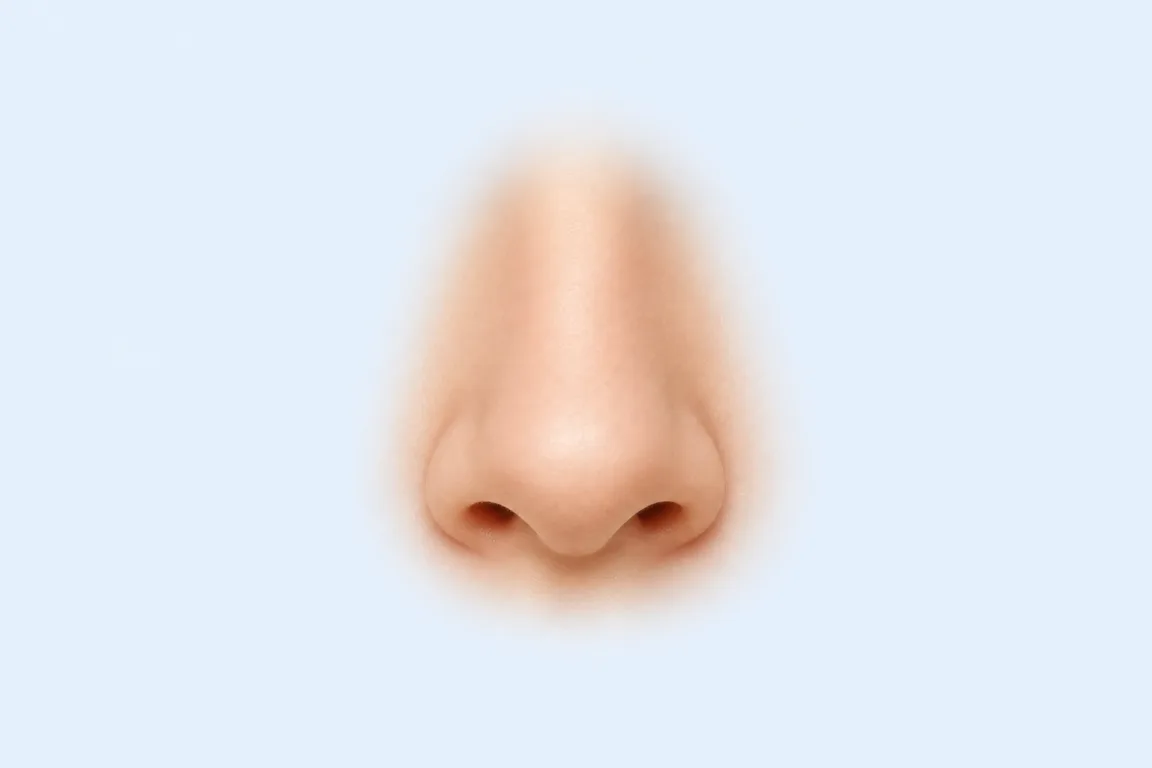
A rounded tip nose has a soft, more circular contour at the lower center. In a front-facing photo, the tip outline looks less tapered and more continuously curved.
Visible features
Study the lower-center outline and ask whether it arcs continuously instead of coming to a sharper join. Roundness is a contour cue at the tip.
Tip width is the horizontal presence of the lower-center mass. Compare contour first, then width.
After the tip is described, compare base width with the rest of the midface. Some rounded tips sit on a clearly wider base, while others stay local with a more moderate alar span.
Detail 1
Rounded tip and bulbous tip sit in neighboring observational territory. Rounded tip emphasizes a soft circular outline.
Detail 2
A straight nose with a rounded tip is a useful combined description because bridge line and tip contour are different layers. Straightness describes how continuously the central path travels from upper bridge toward the tip.
Self-check
Use a front-facing photo with clear lower-center detail. Decide contour before overall width.
Trace the lower-center edge and see whether it forms a soft continuous curve rather than a sharper taper. Keep expression relaxed.
Note how much horizontal room that soft finish uses. Width can support roundness without becoming the whole story.
Compare alar base width with the mouth and midface. Decide whether breadth is local to the tip or shared more broadly.
Compare
Rounded tip is most often confused with pointed tip contour and with overall wide breadth. Isolate the lower-center outline.
What they share
Rounded tip and pointed tip both describe lower-center contour rather than midface length.
The deciding difference
Rounded tip finishes with a softer circular outline. Pointed tip tapers into a more defined lower-center point.
Key visual
Picture a soft arc under the tip for rounded and a tighter taper for pointed on the same bridge path.
What they share
Rounded tip and wide patterns can both look fuller toward the lower nose.
The deciding difference
Rounded tip is a local contour reading. Wide is a multi-zone or whole-structure width reading.
Key visual
First mark the tip outline, then check whether breadth continues through bridge and base.
Personal result
Photo analysis evaluates tip roundness with tip width, base relationships, and the rest of the proportion map. Upload a clear front-facing photo to see whether a rounded tip is the strongest summary for your lower-center contour and which nearby cues remain active.
Analyze your nose shapeFAQs
Rounded emphasizes soft circular contour. Bulbous usually adds an impression of greater lower-center mass.
Not necessarily. Tip contour is local.
Yes. Bridge continuity and tip contour are independent.
Look at the lower-center outline. Rounded forms a continuous soft arc.
Read next
Keep reading nearby nose patterns, or continue with related feature analysis tools.
Nose guide
Short Nose Shape vs Upturned Nose: Key DifferencesIf the soft tip also sits on a compact vertical span, compare a short reading next. Length and tip contour can combine without replacing each other.
Nose guide
Pointed Nose Shape: What It Looks Like and How to Identify ItIdentify a pointed nose shape from tip taper, lower-center definition, and bridge width in context, including long pointed and sharp pointed variations.
Nose guide
Wide Nose Shape: What It Looks Like and How to Identify ItSee how a wide nose shape is identified from relative width, bridge-to-base distribution, and tip breadth in a front-facing photo, plus clear comparisons with narrow and rounded-tip patterns.
Feature tool
Face Shape DetectorSee how your overall face outline frames proportion and feature placement.
Feature tool
Eye Shape DetectorContinue with eye-shape cues for another key facial-feature reading.
Feature tool
Lip Shape DetectorExplore lip shape to add lower-face context to your feature guide.