
Tip Taper
Watch how quickly the outline narrows as it approaches the end of the lower center. Pointed patterns reduce width more decisively than rounded ones.
Nose shape guide · photo-based evidence
Overview
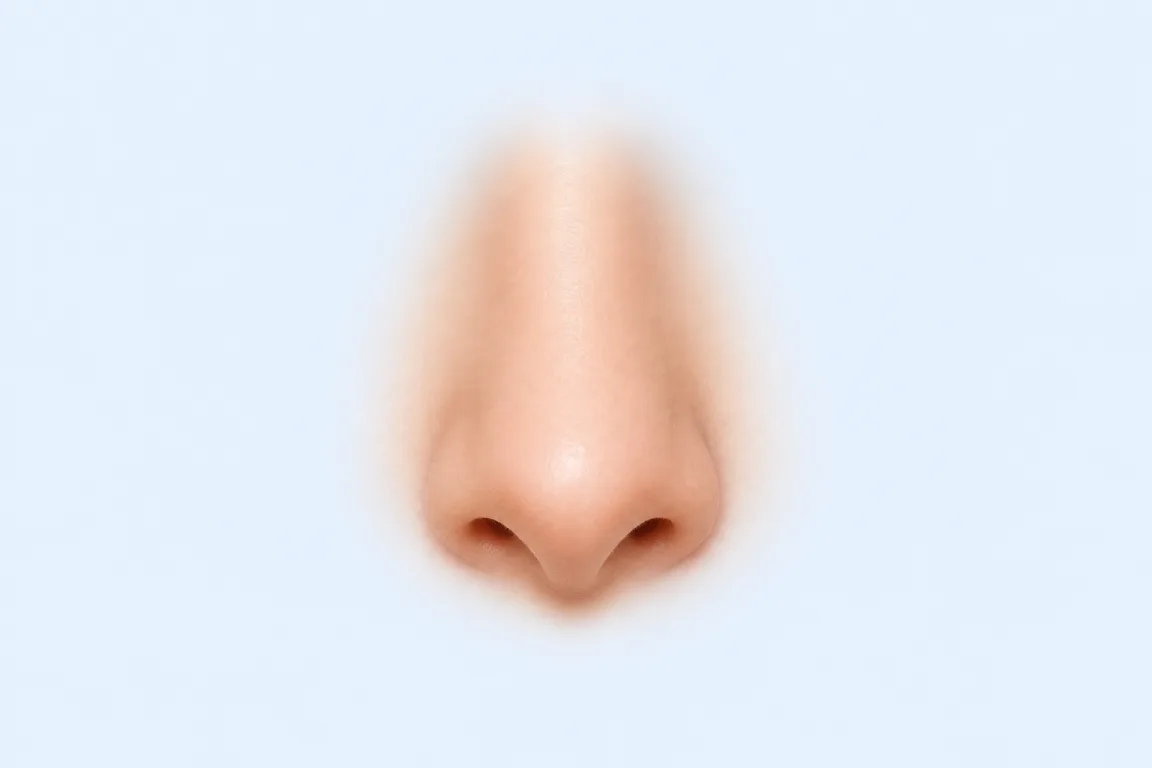
A pointed nose shape, matching the detector’s Pointed Tip result, is a lower-center contour pattern: the tip narrows into a more defined finish rather than resolving as a soft circle. In a front-facing photo, compare taper and definition at the tip, then add bridge width and length as separate details.
Visible features
Watch how quickly the outline narrows as it approaches the end of the lower center. Pointed patterns reduce width more decisively than rounded ones.
Definition is the clarity of the tip finish. A pointed tip usually looks more focused at the end of the center path, with less continuous circular fill than a rounded outline.
After the tip is clear, check bridge and central width. Some pointed tips sit on already slim bridges, which is why pointed and narrow are often mentioned together.
Detail 1
A long pointed nose combines an extended vertical span with a tapered tip finish. Compare bridge-to-tip length first, then the taper at the lower center.
Detail 2
Pointy nose tip phrasing is tip-local and usually agrees with the pointed contour reading. Flat and pointed compare different features: flat refers to bridge projection or tip prominence, while pointed refers to tip taper and definition.
Self-check
Use a clear frontal photo. Judge taper before bridge width.
Follow the lower-center outline and note whether it narrows into a more defined finish instead of a continuous soft arc.
Check that the endpoint looks focused from both sides.
Compare the corridor above the tip. Record whether slimness supports a combined narrow-plus-pointed reading or whether taper is mainly local.
Compare
Pointed tip is most often confused with rounded tip contour and with narrow width. Keep taper separate from the width map.
What they share
Pointed tip and rounded tip both describe the lower-center outline rather than midface length.
The deciding difference
Pointed tip tapers into a more defined finish. Rounded tip keeps a softer circular contour.
Key visual
Compare a narrowing endpoint for pointed with a soft arc for rounded on the same lower-center zone.
What they share
Pointed tip and narrow width often appear together when a slim corridor ends in a tapered finish.
The deciding difference
Pointed names tip contour. Narrow names horizontal distribution through bridge and center.
Key visual
Read tip taper first, then check whether the bridge corridor is independently slim.
Personal result
The detector compares tip contour with bridge width, length, and other proportion cues so a pointed finish is not treated as a full-structure verdict. Upload a clear photo for a personal result that shows whether Pointed Tip is the strongest lower-center pattern on your face.
Analyze your nose shapeFAQs
No. Pointed is tip contour.
Pointed describes taper and definition. Drooping tip describes downward direction.
Split it into length plus tip contour. Confirm extended vertical span first, then confirm that the lower center tapers into a more defined finish.
They are neighboring but separate. Bridge width describes the corridor above; tip taper describes how the outline ends.
Read next
Keep reading nearby nose patterns, or continue with related feature analysis tools.
Nose guide
Drooping Tip Nose: What It Is and How to Identify ItIf the tapered finish also seems to descend, compare a drooping tip next. Direction and taper can stack, and that page keeps the downward cue distinct.
Nose guide
Rounded Tip Nose vs Bulbous Nose Tip: Key DifferencesUnderstand a rounded tip nose from tip roundness, tip width, and base context, including how it differs from a bulbous tip and how a straight bridge can still end in a soft tip.
Nose guide
Narrow Nose Shape: What It Looks Like and How to Identify ItLearn how a narrow nose shape is read from bridge width, central width, and base width in context, and how it differs from pointed tip or long length alone.
Feature tool
Face Shape DetectorSee how your overall face outline frames proportion and feature placement.
Feature tool
Eye Shape DetectorContinue with eye-shape cues for another key facial-feature reading.
Feature tool
Lip Shape DetectorExplore lip shape to add lower-face context to your feature guide.